The most ambitious attempt to replace the VPN trust model with a market - and one of the least convincing products to actually use. The design is real: providers stake OXT, users pay per byte with probabilistic nanopayments (a genuinely clever Ethereum L2), the code is AGPLv3, and the smart contracts passed a real ConsenSys Diligence audit in 2019. But the privacy pitch only holds on paper: circuits default to a single stranger-run hop that sees your IP and destinations, true multi-hop is 'use at your own risk' per Orchid's own FAQ, and the 'preferred providers' curated list quietly re-centralizes the trust the marketplace was built to remove. The product has visibly decayed - iOS last updated 2023, a June 2025 Google Play review reports the app can no longer connect at all, the blog froze in 2022, the protocol subreddit died in 2019, and OXT sits near $0.009, down about 99 percent, leaving the whole incentive machine running on fumes. Pay a dollar to study it if the model interests you; use an accountable VPN if you want privacy that someone is answerable for.
auditopen sourcecrypto accepted5 red flagsfacts verified - operator pages (orchid.com home/vpn/oxt/privacy-policy, docs.orchid.com home/FAQ/accounts, blog.orchid.com incl. the $1-getting-started and 8-blockchains posts, App Store, Google Play, GitHub repo, whitepaper PDF), the ConsenSys Diligence audit page, reviews (Cloudwards, TechRadar, Macworld), Decrypt and Cointelegraph news, the IVPN dVPN guide, privacytools.io dVPN list, CoinGecko price API, Reddit archives (arctic-shift) and the HN Algolia API were all fetched live on 2026-11-02
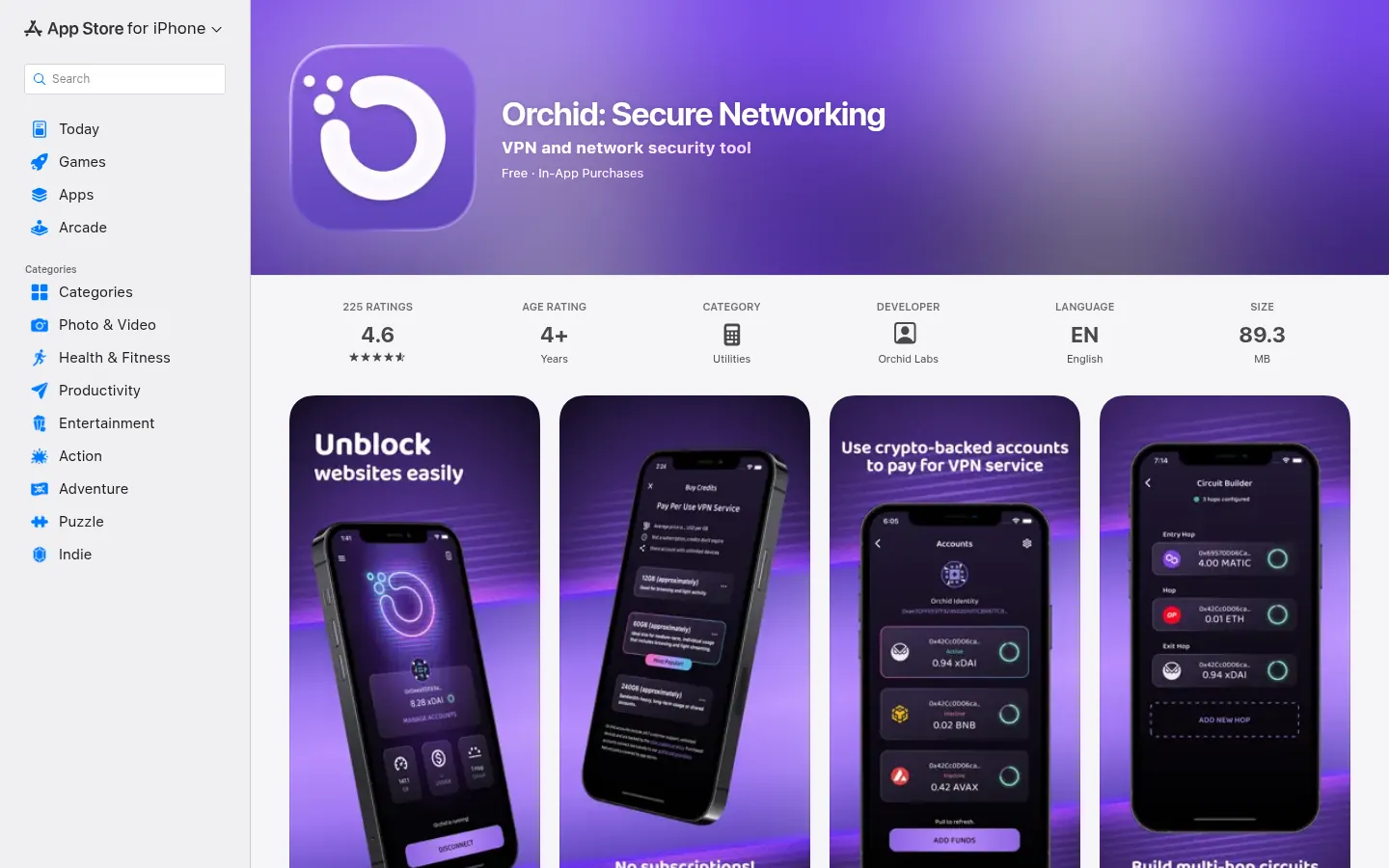
Token collapse and product stagnation: OXT at roughly $0.0088 with an ~$8.8M market cap (CoinGecko, 2026-11-02); iOS version 0.9.43 dated 2023, Android last updated Dec 2024, and a June 2025 Play review reports the app stuck at 'querying ethereum for a random provider' and never connecting after Ethereum changed under the frozen app
Community and communications are dormant: the official blog has been frozen since 2022 (footer still says '2023 Orchid Labs Inc.'), the protocol subreddit has been effectively dead since 2019, and orchid.com's own footer links to reddit.com/r/orchid - a flower-growing subreddit
The privacy policy was last updated August 16, 2019 (pre-dating the desktop apps, as Cloudwards flagged) - the core no-logging claim has never been audited or independently verified
+2 more red flags - expand before signing up
Curated-list centralization: single-hop traffic is pre-filtered to a non-public list of 'trusted VPN partners' (Tenta, Bloq, BolehVPN, VPNSecure and similar per reviews) - the operator acts as kingmaker over the marketplace it markets as leaderless
Cryptocurrency is not anonymity here: winning nanopayments publicly link payer and provider addresses on-chain, and buying OXT or app credits through an exchange or app store can identify you (operator FAQ concedes both)
Review
draft generated by Qwen3, fact-checked by the vpncomparison editorial desk · review version 2 · prose updated 2026-11-02 · facts as of 2026-11-02 · how we verify
Honesty note: we have not run our own tests on Orchid (OXT pay-per-use multi-hop dVPN) yet (leak tests, speed, kill switch). Everything on this page is source-based meta-research with dated links. When we test it, results appear here and on the change log.
Overview
Orchid (OXT pay-per-use multi-hop dVPN) homepage - live capture 2026-09-29
Orchid is a decentralized VPN (dVPN) marketplace using pay-per-byte bandwidth from independent providers, paid via cryptocurrency nanopayments. It’s not a traditional subscription service - users buy credits (starting at $1) to access a global pool of staked OXT providers. Run by Orchid Labs in San Francisco, it promises privacy through multi-hop routing, but the project has visibly stalled: apps are outdated, the blog is frozen since 2022, and the token has collapsed. This is a crypto experiment, not a polished privacy tool.
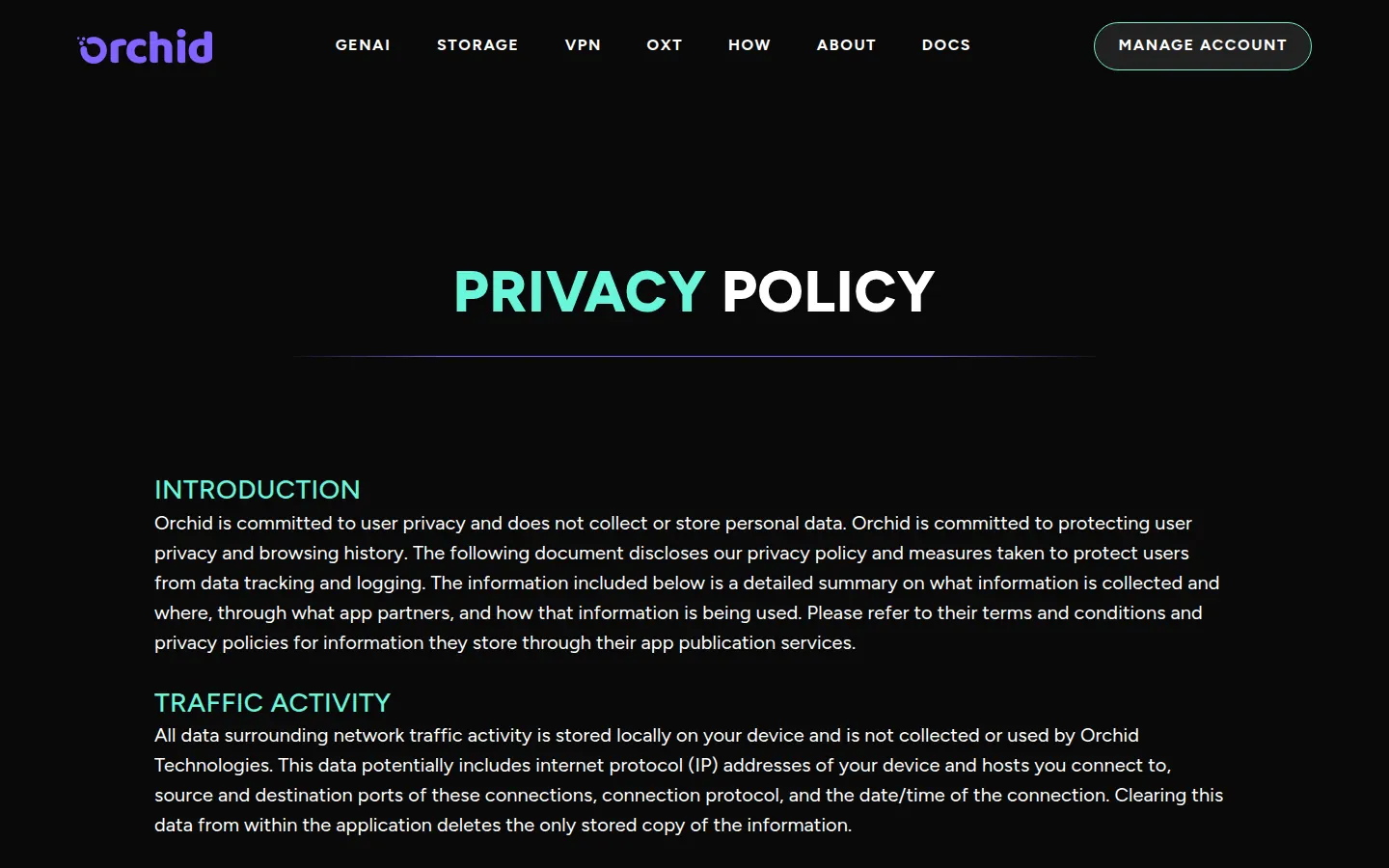
Orchid claims it “does not collect or store personal data,” with all traffic logs stored only locally on your device. However, this no-logs assertion is policy-only - it’s never been audited or independently verified. The privacy policy hasn’t been updated since August 2019, predating its desktop apps. While the architecture aims to split identity and traffic across hops, circuits default to a single provider, which sees your real IP and destinations and could log them. True multi-hop is “use at your own risk” per Orchid’s FAQ. Winning nanopayments also publicly link user and provider addresses on-chain. Jurisdiction is the U.S., but exit nodes are third parties worldwide.
Pricing & the renewal trap
Orchid has no subscriptions - just a $1 minimum prepaid credit (via in-app purchase or crypto) to start. There is no renewal price or billing cycle, so the renewal ratio is not applicable. Credits do not expire, and there’s no free tier. In-app top-ups are $1, $5, or $20 with no volume discount. The real cost varies: historical data suggests ~$0.06 per GB, but prices depend on provider bids, OXT value, and gas fees. The three-year cash total is not computable due to the pay-as-you-go model. Payments include fiat (via Apple/Google) or crypto (OXT, ETH, xDAI), with no KYC.
Orchid supports OpenVPN, WireGuard, and its custom WebRTC-based protocol, with multi-hop routing and a built-in kill switch. It’s open-source (AGPLv3), available on iOS, macOS, Android, and Linux - no Windows GUI, only a CLI beta. Server count and countries are undefined, as exits are run by third-party providers. P2P support is unconfirmed; streaming is not supported due to lack of location control. Performance varies: Cloudwards tested speeds between 24.5-34 Mbps, but a June 2025 Google Play review reports the app failing to connect, likely due to Ethereum changes. No independent speed or leak tests have been conducted recently.
Ownership & track record
Orchid Labs Inc., based in San Francisco, was founded in 2017 by crypto and tech veterans, backed by Andreessen Horowitz and Sequoia. Despite early hype and a $43M token sale, the project has stagnated: the iOS app hasn’t updated since 2023, the blog since 2022, and the protocol subreddit is dead. OXT trades at ~$0.0088, down 99% from its peak. Red flags include a curated list of “trusted” providers (re-centralizing trust), unverified privacy claims, and an app that may no longer function post-Ethereum upgrades. The data quality is verified, but the project’s operational health is in serious doubt.
Censorship resistance
Orchid’s WebRTC-based protocol is designed to resemble normal browser media traffic, aiding firewall evasion. Multi-hop circuits can help bypass censorship, as ISPs see only encrypted Orchid traffic. However, there’s no confirmed use in high-censorship regions like China or Iran. The lack of active development and reports of connection failures suggest it may not reliably work on hardened networks. For users in censored environments, Orchid is not a recommended tool - proven solutions like Tor or audited commercial VPNs with obfuscation are safer bets.
Verdict
Orchid is a fascinating but failed experiment: a decentralized, pay-per-byte VPN that promised to disrupt the industry but collapsed under technical debt and token economics. It’s only worth $1 to study the model - not to rely on for real privacy. The no-logs claim is unverified, the app may not even connect, and the ecosystem is dead. Use a reputable, audited VPN if you need accountability. Orchid does not appear to fund affiliate reviews.
++ What holds up
True pay-as-you-go: from $1 in prepaid credit, nothing charged while the VPN is off, no subscription and credits that do not expire (operator docs + Google Play, live 2026-11-02)
Fully open source under AGPLv3 with unusually candid build docs and a built-in traffic analyzer in the client
No account, no email, no KYC for self-custodial crypto accounts; apps carry a 'no data collected' label on both app stores
Multi-chain deposits across 8+ EVM chains keep on-ramp/off-ramp fees low
When it works, some users report speeds that beat centralized VPNs (Google Play review 2023; HN 2022 praises the cross-provider multi-hop as closer to Tor)
-- What to watch
Cannot choose a server location or country - exit is a random draw (docs and every review); geo-unblocking is effectively impossible by design
Default configuration is a single hop: the one stranger-provider sees your real IP and unencrypted destinations - the exact trust problem the product exists to solve (IVPN guide + Orchid's own FAQ)
Multi-hop is manual, fiddly and officially 'use at your own risk'; per-hop funding from the same wallet can link your own hops (FAQ)
Speed is a lottery: roughly 10 percent of base speed in Macworld's 2021 tests, 'incredibly variable and mostly slow' per vpnMentor-class reviewers, 24.5-34 Mbps spread across providers in Cloudwards' tests
App quality and support are weak: cloudwards rates ease of use 'Terrible' (40/100), a 2025 Play review shows the app failing to connect at all, and support is effectively email plus a dormant docs site
Costs scale with usage - heavy use costs more than any flat-rate VPN (Cloudwards: 'gets expensive with high data usage'; Macworld: $40 bundle = 6-8 months of an unlimited subscription)
No refund policy, no free trial, no split tunneling, no Windows GUI (only a command-line beta); Cloudwards' 2026 testing still found no kill switch in the app despite the docs describing built-in kill-switch behavior - a documented discrepancy
The whole marketplace depends on OXT, now at about $0.009 (down ~99 percent from 2021) - deposit/ticket economics wobble with token price and gas, per the operator's own efficiency docs
Pricing reality check
Intro price
$1 /one-time
Notes
Current official docs (docs.orchid.com 'Using the Orchid app', fetched 2026-11-02): 'open the Orchid app, tap Get started for $1, and confirm the $1 USD (or equivalent local currency) in-app purchase', which funds a 0.10 xDAI deposit plus roughly 0.87 xDAI balance on the xDAI chain; in-app top-up presets are $1, $5 and $20 with 'no significant advantage in terms of pricing for purchasing a larger account'; Google Play listing says 'Start for as little as $1'. The app home screen shows the live average price per GB, polled from a Chainlink oracle averaging provider prices across the network, and 'varies from provider to provider'. Historical official rate was about $0.06 per GB (operator blog Mar 2021, echoed by Decrypt quoting CEO Steven Waterhouse and by Cloudwards, ~15.5-16.7 GB per $1). Per the operator's 8-blockchains post, bandwidth is 'charged in USD and converted at the current market price of the native token'. No static current per-GB figure is published anywhere, so real-world cost moves with provider prices, OXT price and chain gas fees. IAP-funded accounts are custodial (managed funder wallet, non-withdrawable crypto); dApp accounts are self-custodial.
Check the renewal price above before any multi-year plan - true-cost calculator.
Is Orchid legit?
Legal domicile: United States - Orchid Labs Inc. / Orchid Technologies LLC, 1288 Columbus Ave, San Francisco, CA (Google Play developer listing); bandwidth exits are run by independent third-party providers worldwide, not by the company. Logging claim: Orchid: 'committed to user privacy and does not collect or store personal data'; all traffic-activity data (IP addresses, ports, protocol, timestamps) is stored locally on the device and is never collected by Orchid Technologies (site privacy policy) - evidence class: promise only (no proof). No incidents on file in our research - absence of evidence is not proof of innocence. Facts verified - operator pages (orchid.com home/vpn/oxt/privacy-policy, docs.orchid.com home/FAQ/accounts, blog.orchid.com incl. the $1-getting-started and 8-blockchains posts, App Store, Google Play, GitHub repo, whitepaper PDF), the ConsenSys Diligence audit page, reviews (Cloudwards, TechRadar, Macworld), Decrypt and Cointelegraph news, the IVPN dVPN guide, privacytools.io dVPN list, CoinGecko price API, Reddit archives (arctic-shift) and the HN Algolia API were all fetched live on 2026-11-02 (not fully verified) as of 2026-11-02 - read the sources below.
The money trail - what review sites earn by recommending this
affiliate status not verified yet
If we sign up for this program, every link here becomes rel="nofollow sponsored" and routes through /go/. Until then our links point straight to the provider's website with zero tracking. Ranking logic physically cannot read affiliate fields - here is the proof.
On the website
Captured by our screenshot bot from the live site (or its public archive). A capture is evidence of what the page showed at capture time - not an endorsement.
Based on our checks as of 2026-11-02: Orchid (OXT pay-per-use multi-hop dVPN) scores 4.3/10 in our weighted review. We logged 5 red flags (listed above). User reports, ownership and the incident record are documented with dated sources in the meta-review below.
What do I actually get for $1?
You get a prepaid credit that funds a small xDAI balance and deposit to start using bandwidth. At ~$0.06 per GB, $1 buys roughly 15-16 GB, but actual cost varies by provider and network conditions. No subscription, no expiration.
What is the renewal price and total cost over three years?
There is no renewal - Orchid is pay-as-you-go. The three-year cash total is not computable because you only pay for data used. Heavy usage could cost far more than a flat-rate VPN.
What evidence supports Orchid’s no-logs claim?
None beyond its 2019 privacy policy. No audits verify logging practices. The claim is policy-only, and the FAQ admits single-hop providers can see and log your traffic.
Does Orchid work in censored countries like China or Iran?
Unknown, but unlikely. No evidence confirms reliable use there. The app may not even connect due to outdated Ethereum integration. It is not recommended for high-censorship environments.
Can I pay anonymously?
Yes, if you use the self-custodial dApp with OXT or xDAI. In-app purchases via Apple/Google tie your payment to your account, but Orchid itself collects no personal data.
What happens if Orchid shuts down?
If the app or network fails, you lose access. The June 2025 Google Play review already reports connection failures. Since the project is inactive, long-term reliability is not guaranteed.
What’s an honest free or cheap alternative?
For real privacy, use a reputable, audited provider like IVPN or Mullvad. For free, Tor Browser offers stronger anonymity than Orchid ever did. Avoid dVPNs for daily use - they’re not ready.
The meta-review: what the internet says about Orchid (OXT pay-per-use multi-hop dVPN)
We do not expect you to trust us. This review is a meta-review: below you see what other review sites claim - with their conflicts of interest labeled - what users report on Reddit and forums, and who actually operates Orchid (OXT pay-per-use multi-hop dVPN). Every claim links to its source so you can verify it yourself.
What other reviewers say (3)
Every source carries a conflict label from our review-site database. "Affiliate-funded" means the site earns money if you buy what it recommends. We include critical voices deliberately.
Fetched 2026-11-02 (HTTP 200): 'a nice idea in theory, but flounders in practice'; ease of use rated 40/100 Terrible; no kill switch, split tunneling or server choice; no Windows GUI; ~$0.06/GB, ~15.5 GB per $1, 'gets expensive with high data usage'; speeds 24.5-34 Mbps across random providers in tests; no leak observed; privacy policy stale since 2019; curated provider list not public; verdict: 'built a wheel that doesn't roll' - a godsend only for deep crypto users. Affiliate-funded site (per its own disclosure), independent of VPN operators.
Fetched 2026-11-02 (HTTP 200): pay-as-you-go praised; average pricing $0.06/GB at the time; IAP packages $0.99/$4.99/$19.99; no free trial or money-back guarantee; speeds below average (34.75 Mbps test, 2.58 Mbps on an earlier pass); Android 4.0/5 from 440 ratings, iOS 4.8 from 12; credits do not expire; unlimited simultaneous connections. Note: affiliate-funded Future plc property.
Fetched 2026-11-02 (HTTP 200): then-current Mac App Store bundles $40/$80/$200; '3 to 8 cents per gigabyte' per the company; maintained about 10 percent of base speed (~10 Mbps); every connection landed in the US; Netflix not bypassed; provider exits then included PIA, BolehVPN, Liquid VPN, VPNSecure; stake withdrawal can take up to three months; WebRTC encryption ECDSA P-256/SHA-256; 'not something we see having mass appeal'.
What users say (2)
Reddit, forums, HN - paraphrased and linked, never quoted out of context. Anecdotes, not proof - but refund complaints and leak reports are the best early-warning system this market has.
Fetched 2026-11-02 (HTTP 200): 15 comments, all 2018-2019 - token-incentive enthusiasm, 'Tor is slow as hell, hope this does not turn into a speculative coin', founder (gustav_simonsson) replies incl. rehosting a whitepaper that vanished from the website, and 2019 'this project seems on hold, try NKN/Mysterium'. The same subreddit's 25 most recent comments (HTTP 200) end in June 2019 - the protocol community is dormant. Note: searches against r/VPN and r/dVPN with a body= filter returned HTTP 422 (server-side 'Timeout. Maybe slow down a bit') on five attempts.
Fetched 2026-11-02 (HTTP 200): 75 hits - cross-provider multi-hop praised as closest-to-Tor (ignoramous 2022), trust-distribution explanations (mirimir 2020), CTO saurik defending the design across threads (2017-2022), token-valuation skepticism at the 2021 peak ($737M fully diluted). Original 2017 launch story 'Orchid: a new surveillance-free layer' drew 378 points / 188 comments (story 15576457).
AI fact summary - everything we know, compressed
Generated by Qwen3 on 2026-11-02 from our fact database plus the linked sources. It summarizes - it does not add facts. Check anything that matters against the linked sources.
Bottom line: Orchid is a pay-as-you-go decentralized bandwidth marketplace, not a traditional VPN. It’s built for crypto-native users who want per-byte billing and self-custodial accounts, but the product has visibly decayed: the iOS app hasn’t updated since 2023, Android stalled in 2024, and the official blog froze in 2022. Real-world usability is poor, with no server selection, no Windows GUI, and reports of connection failures due to outdated Ethereum integration.
The logging truth: Orchid claims it collects no personal data and stores traffic logs only locally, but this is policy-only - last updated August 16, 2019, before desktop apps existed - and has never been audited. Single-hop connections, which are default, expose your real IP and traffic destinations to one provider who could log them; Orchid’s own FAQ admits this. The U.S.-based Orchid Labs Inc. operates under jurisdiction with surveillance laws, though the protocol routes through independent global providers.
Pricing reality: There is no subscription - only a $1 minimum prepaid credit (up to $20) for in-app purchases, funding a custodial xDAI account. The historical rate was ~$0.06 per GB (~16.6 GB per dollar), but real-time pricing varies by provider, OXT value, and gas fees. No volume discounts exist, and heavy usage becomes expensive. Credits don’t expire, but the model favors light, sporadic use.
What reviewers say vs what users say: Affiliate reviewers (TechRadar, Macworld) once praised the concept and pricing but noted poor speeds and no streaming support. Cloudwards’ 2026 update - conflict noted as affiliate-funded - slams it as “the least user-friendly” and “a wheel that doesn’t roll.” Users echo this: a June 2025 Google Play review reports the app fails to connect, stuck on “querying Ethereum.” Some praise speed when it works, but most confirm stagnation and broken functionality.
Who runs it: Orchid Labs Inc. / Orchid Technologies LLC, based in San Francisco, founded in 2017 by Stephen Bell, Steve Waterhouse, Jay Freeman (saurik), Brian Fox, and Gustav Simonsson, with backing from a16z, Sequoia, and DFJ. The team is no longer active - no public updates since 2022 - and the project appears abandoned despite the domain being up.
Sources & how this review was built
Every external source used on this page, with the date we fetched it and its evidence class [A]-[D] (A = primary/operator, B = serious press/research, C = community, D = our own measurements). Methodology: how we verify. Sources disappear or change - if a link is dead, tell us via contact.
Evidence classes on this page:[A] A: 17[B] B: 8[C] C: 2[D] D: 0(D stays empty until our own test phase)
Sentinel is real decentralized-VPN infrastructure - an open-source Cosmos chain with on-chain sessions, Wallet-only signup and per-gigabyte pricing that…
open sourcecrypto accepted
intro $1 /mo
none verifiable (no legal entity confirmed 2026; on-chain governance via P2P stakers, docs maintained by validator Trinity - whitepaper-era SNT Foundation / Exidio unconfirmable)decentralized vpn (dvpn) 11 d ago
A genuine dVPN with real scale (22,000+ active nodes in 135+ countries per the network homepage, 45k bandwidth providers per MystNodes, both fetched…
auditopen sourcecrypto accepted
intro $2.29 /mo
Switzerland and Lithuania - Blockdev AG (Alpenstrasse 14, 6300 Zug, footer fetched 2026-11-02) develops the network; the consumer VPN app is operated by UAB 'MN Intelligence' (Lithuanian company form, mysteriumvpn.com footer fetched 2026-11-02); discovery services run by NetSys Inc; terms-conditions-vpn states disputes are governed by the laws of the Republic of Panama with exclusive jurisdiction in Panamanian courtsdecentralized vpn (dvpn) 11 d ago
Althea should not appear in any consumer VPN comparison as a VPN, and this dossier exists mainly to say so precisely: the project started (2017-2019) as a…
open sourcecrypto accepted
free
United States - docs.althea.net footer reads 'Althea Limited 2025'; Fierce Network (May 2024) identifies Deborah Simpier as CEO of Hawk Networks, 'the company behind the Althea platform'; the L1 chain itself is a global proof-of-stake network with no clear single legal seat publisheddecentralized vpn (dvpn) 10 d ago



No comments yet - be the first. Posting runs a short proof-of-work in your browser (anti-spam), no account needed.