The most honest thing to say about Opera's 'VPN' is what Opera's own documentation quietly admits: it is a browser-scoped secure proxy, not a VPN. The Android help page calls the tunnel 'this proxy'; Opera's Reddit account confirms it protects 'only within the Opera browser'; independent reviews (Tom's Guide 2019, TechRadar 2025) and a 2016 technical analysis all reach the same conclusion. Within that scope it is surprisingly credible: a Deloitte no-log audit of the free tier (2024), a Cure53 white-box security assessment (2021-22), three real physical locations, no account, no data cap, and a transparently explained business model (ads + Google search revenue + VPN Pro upsell), under Norwegian GDPR jurisdiction. The caveats are structural. First, the proxy-not-VPN gap: no other app on the device is protected, there is no kill switch, and unblocking power is effectively zero (TechRadar scored unblocking 0/10 - it failed Prime Video, Disney+, Paramount+ and BBC iPlayer). Second, the ownership lineage: the browser business was carved out of Norwegian Opera Software in 2016 by a consortium led by Kunlun Tech and Qihoo 360 after a CFIUS privacy-review scare, and Kunlun now holds roughly 69% - a Chinese corporate parent behind a tool that sees your unproxied-by-anyone-else traffic. Third, history: the original mobile 'Opera VPN' was SurfEasy infrastructure whose 2017 investor deck touted reselling anonymized subscriber data for market intelligence. As a free, zero-effort transport-encryption layer for browser traffic on hostile Wi-Fi, it is a reasonable convenience feature. As anonymity or a replacement for a real VPN, it is not one - which matches this site's framing: built-in browser relays are transport encryption, not anonymity.
audited6 red flagsfacts verified - operator pages (opera.com/features/vpn, /features/free-vpn, /features/vpn-pro, /legal/privacy, help.opera.com VPN FAQ, Opera security blogs for the Cure53 2022 and Deloitte 2024 audits and the 2026-06 monetization explainer), Wikipedia Opera (company), the Cision 2016 sale announcement, TechRadar 2025 free-VPN review + 2026 auto-connect news piece, Tom's Guide 2019 review, Privacy Guides browser criteria, Michal Spacek's 2016 proxy analysis, the WWW 2018 academic paper PDF, the arctic-shift Reddit archive (r/operabrowser) and the HN Algolia API - all fetched live 2026-11-03
outbound link - direct to the provider, no affiliate parameters
site unreachable (HTTP 451) · checked 19 h ago · daily check
Red flags (6):
China ownership lineage: 2016 sale of Opera's browser/VPN consumer business to a Golden Brick consortium led by Kunlun Tech and Qihoo 360 for $600M after the original $1.2B full takeover failed regulatory review amid US privacy concerns (CFIUS context documented by Reuters and AdExchanger); the reduced deal was approved by CFIUS on 31 Oct 2016; Kunlun now holds ~69% and Zhou Yahui chairs Opera's board (Wikipedia, fetched 2026-11-03)
The proxy-not-VPN gap: marketing says VPN, engineering says proxy - Opera's own help page ('This proxy is also used for WebRTC and DNS'), the settings label 'Secure proxy', and Opera's Reddit admissions; WebRTC was initially excluded entirely in 2016 (Spacek/gHacks analysis)
SurfEasy-era data resale: the original Opera VPN mobile apps ran on SurfEasy infrastructure; a 2017 SurfEasy investor slide surfaced on HN lists 'Opera VPNFree... Anonymized subscriber data resold to third parties for market intelligence'; the mobile apps were shut down in April 2018 after Symantec bought SurfEasy
+3 more red flags - expand before signing up
A 2019 HN comment asserts 'Opera VPN collects user data. It's right in their policy' (community claim, predating the current no-log wording and the 2024 Deloitte audit - unverified against today's policy)
Opera also sells targeted ads and profiling in the same browsers the VPN lives in (privacy statement: personalized ads based on IP, hashed ID and general location) - the no-log VPN boundary is narrow by design
VPN Pro's infrastructure is third-party ('provided in collaboration with Nord', per Opera's audit blog) and Opera's own policy concedes 'we do not promise that the service is absolutely secure'
Review
draft generated by Qwen3, fact-checked by the vpncomparison editorial desk · review version 2 · prose updated 2026-11-03 · facts as of 2026-11-03 · how we verify
Honesty note: we have not run our own tests on Opera VPN (browser) yet (leak tests, speed, kill switch). Everything on this page is source-based meta-research with dated links. When we test it, results appear here and on the change log.
Overview
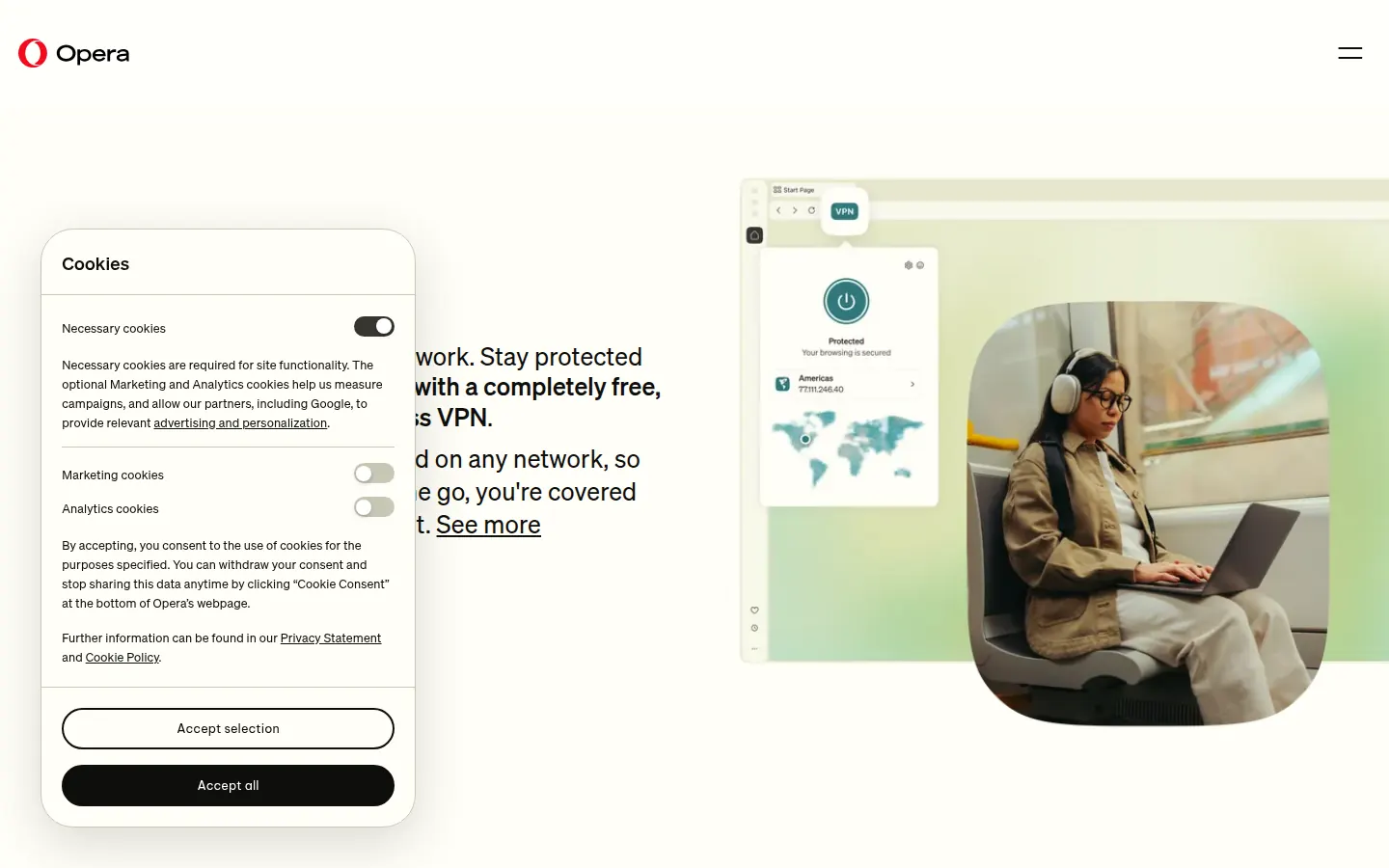
Opera VPN (browser) homepage - live capture 2026-09-29
Opera VPN is a free, browser-bundled HTTPS proxy marketed as a "VPN" inside the Opera, Opera GX and Opera Air browsers. It encrypts only browser traffic, not your full device. The tool is operated by Opera Ltd., majority-owned by Chinese firm Kunlun Tech, though the free tier’s infrastructure is under Norwegian jurisdiction. The core caveat: this is not a system-wide VPN, and its privacy value is limited to transport encryption within the browser.
Logging & privacy
Opera claims a no-log policy for its free browser VPN, stating it collects no browsing activity, originating IP, or personal data. This claim is backed by a 2024 Deloitte audit covering the free tier’s infrastructure across desktop and mobile, verifying the absence of logging functionality. A 2022 Cure53 security assessment found and confirmed fixes for 14 issues. However, the audit explicitly excludes the paid VPN Pro tier, which runs on third-party infrastructure (confirmed as Nord). Jurisdiction is split: data processing occurs under GDPR via Opera Norway AS, but ultimate corporate control lies with Kunlun Tech in China. There is no warrant canary.
Pricing & the renewal trap
The free browser VPN has no cost, no account, and no data cap. The optional paid tier, VPN Pro, costs $7.99/month, $29.99 for six months, or $39.99/year (advertised as $3.33/month). It includes a 7-day free trial and a 30-day money-back guarantee. Since the free tier requires no payment and there is no renewal for it, the derived_pricing shows no renewal ratio or multi-year cost. The business model relies on search partnerships (e.g., Google), ads, and upselling to VPN Pro.
Features & performance
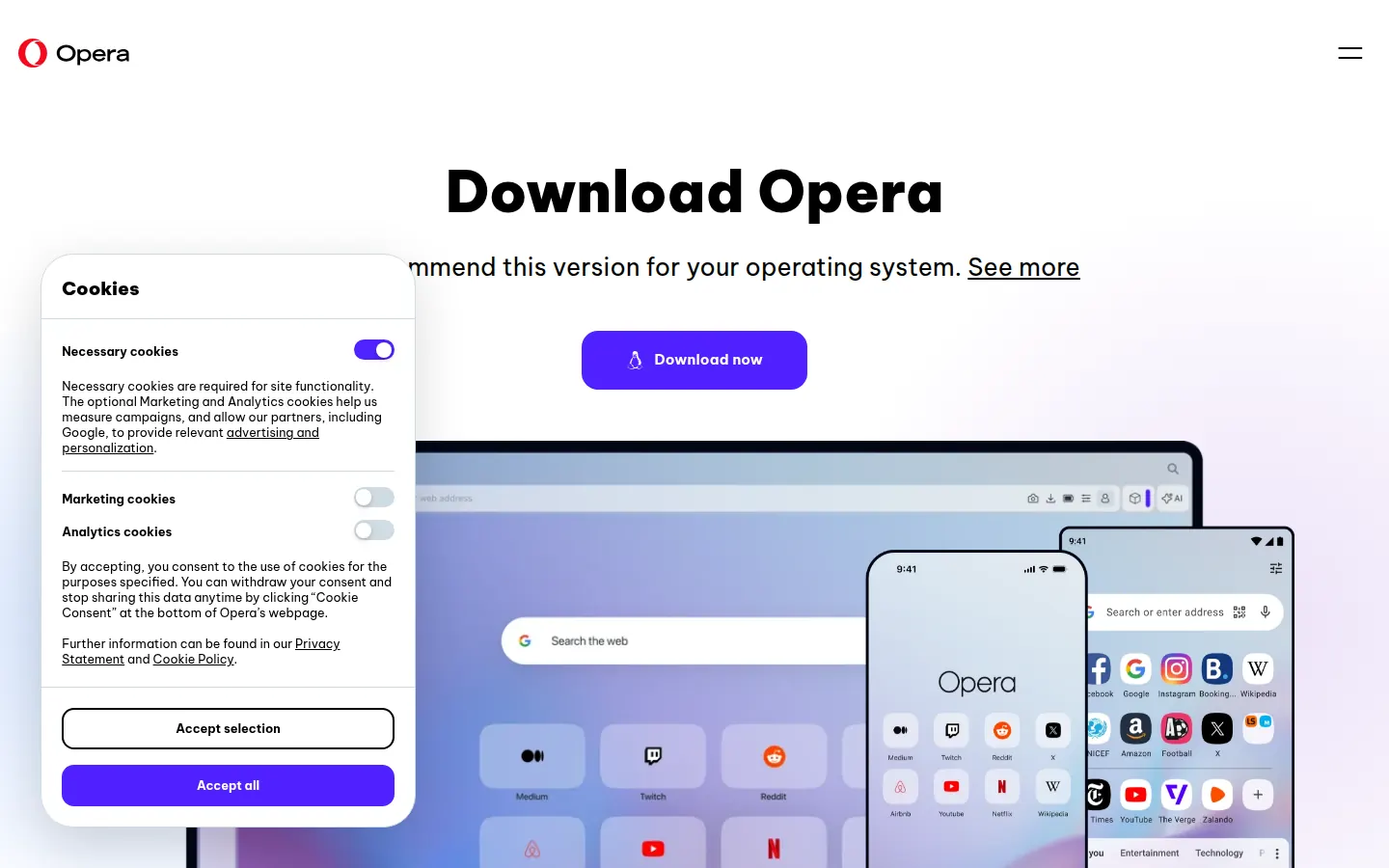
Opera VPN (browser) apps / download page - live capture 2026-09-29
The free tier supports IPSec/IKEv2 (Windows/macOS), OpenVPN (Android), and WireGuard (iOS), with split tunneling available per site. It lacks a kill switch, multihop, P2P support, streaming unblocking, and system-wide protection. Servers are limited to three real locations: Ashburn (US), Amsterdam (NL), and Singapore, with Opera claiming 100+ servers. Independent testing (TechRadar 2025) confirms it fails to unblock major streaming platforms and offers no protection outside the browser. No performance tests have been conducted by this site.
Ownership & track record
Opera’s consumer business, including the browser and VPN, was sold in 2016 to a consortium led by Kunlun Tech and Qihoo 360 after U.S. regulators raised privacy concerns. Kunlun now holds ~69% and controls the board. The free tier’s current no-logs claim is audit-verified (Deloitte 2024), but the historical record includes data resale: the original mobile "Opera VPN" used SurfEasy infrastructure, whose 2017 investor deck listed anonymized user data being sold for market intelligence. Opera’s own documentation and Reddit responses confirm the free version is a browser-only proxy, not a full VPN.
Censorship resistance
Opera’s free browser VPN offers no obfuscation features and is not designed for censorship circumvention. It has been blocked in Russia, and there is no evidence it works in high-censorship environments like China or Iran. Since it only encrypts browser traffic and lacks obfuscation, it is ineffective against sophisticated network filtering. Users in censored regions should consider purpose-built tools with proven obfuscation, such as Tor or audited, obfuscated commercial VPNs.
Verdict
Use Opera’s free “VPN” only if you want zero-effort, in-browser encryption on public Wi-Fi and already use Opera. It is not a real VPN, offers no anonymity, and cannot protect non-browser apps or unblock streaming. The Deloitte audit adds credibility to its no-logs claim within its narrow scope, but the Chinese ownership and historical data resale should give pause. This provider does not pay review sites - its promotion is baked into the browser itself.
++ What holds up
Genuinely free, unlimited and accountless - no email, no data cap, no ads, one click in the address bar (operator page + FAQ, live 2026-11-03)
Deloitte no-log audit of the free tier's infrastructure (Jun-Aug 2024) plus a Cure53 white-box security assessment with fixes verified - unusual diligence for a free feature
Norwegian data controller under GDPR, with a published transparency report and NASDAQ/SEC reporting obligations
Per-site 'bypass rules' split tunneling in the free tier (a feature missing from the paid Pro tier)
New September 2026 opt-in auto-connect on public Wi-Fi closes the biggest practical failure mode of browser VPNs
-- What to watch
It is a proxy, not a VPN: browser traffic only - every other app is unprotected; Opera's own help doc and Reddit account admit the scope
No kill switch (tested and confirmed by TechRadar 2025), no obfuscation, no multihop, no way to choose a protocol
Unblocking is near zero: TechRadar's 2025 testing scored 0/10 (failed Prime Video, Disney+, Paramount+, BBC iPlayer); speeds swing from 380 Mbps to 2 Mbps depending on time of day
Only 3 free locations (Americas/Asia/Europe labels, not country selection) and a small server pool versus dedicated free VPNs like Proton or Windscribe
Privacy Guides does not recommend Opera (its browser criteria require open-source software, which Opera is not)
VPN Pro requires an Opera account and runs on Nord-operated third-party infrastructure whose policy Opera summarizes rather than warrants
none for the free VPN; email + payment method for the VPN Pro subscription
Payment
fiat
Money-back window
30 days
Apps
windows, mac, linux, android, ios
Check the renewal price above before any multi-year plan - true-cost calculator.
Is Opera VPN legit?
Legal domicile: Norway (Opera Norway AS, Oslo - data controller under GDPR) / listed on NASDAQ as Opera Ltd.; ultimate control: Kunlun Tech Co., Ltd., a Shenzhen-listed Chinese company holding roughly 69% of shares, controlled by Zhou Yahui (executive chairman of Opera's board); VPN Pro infrastructure operated by a third party (Nord). Logging claim: No-log. Privacy statement (last updated 2026-10-02): 'Our free, built-in browser VPN is a no-log service... we do not log any personal data, or any other data, related to your browsing and originating network address on our servers while you use the VPN.' Help FAQ: 'Our VPN is a no-log service, which means that we do not collect any information that travels through our VPN servers.' Deloitte-tested management assertion: 'There is no data logging functionality built into the VPN service, and no data whatsoever is collected about users' browsing activity, browsing history, originating network address, or other identifying information.' - evidence class: independently audited. No incidents on file in our research - absence of evidence is not proof of innocence. Facts verified - operator pages (opera.com/features/vpn, /features/free-vpn, /features/vpn-pro, /legal/privacy, help.opera.com VPN FAQ, Opera security blogs for the Cure53 2022 and Deloitte 2024 audits and the 2026-06 monetization explainer), Wikipedia Opera (company), the Cision 2016 sale announcement, TechRadar 2025 free-VPN review + 2026 auto-connect news piece, Tom's Guide 2019 review, Privacy Guides browser criteria, Michal Spacek's 2016 proxy analysis, the WWW 2018 academic paper PDF, the arctic-shift Reddit archive (r/operabrowser) and the HN Algolia API - all fetched live 2026-11-03 (not fully verified) as of 2026-11-03 - read the sources below.
The money trail - what review sites earn by recommending this
affiliate status not verified yet
If we sign up for this program, every link here becomes rel="nofollow sponsored" and routes through /go/. Until then our links point straight to the provider's website with zero tracking. Ranking logic physically cannot read affiliate fields - here is the proof.
On the website
Captured by our screenshot bot from the live site (or its public archive). A capture is evidence of what the page showed at capture time - not an endorsement.
Opera VPN (browser) homepage - live capture 2026-09-29Opera VPN (browser) apps / download page - live capture 2026-09-29
Before you pay: check the renewal price, the refund window, and whether a cheaper or free path covers your use case - the honest checklist.
Based on our checks as of 2026-11-03: Opera VPN (browser) scores 4.5/10 in our weighted review. We logged 6 red flags (listed above). Its logging claim is backed by an independent audit. User reports, ownership and the incident record are documented with dated sources in the meta-review below.
What do I actually get with the free Opera VPN?
You get browser-only HTTPS proxy encryption with AES-256, three location choices, no account, and no data cap. It does not protect apps outside the browser, lacks a kill switch, and cannot unblock streaming services.
What is the renewal price and total cost over three years?
The free tier has no cost and no renewal. The `derived_pricing` shows no renewal ratio or three-year total because no payment is required for the free service.
What evidence supports the no-logs claim?
A 2024 Deloitte audit verified no logging functionality in the free browser VPN infrastructure. The audit covered desktop and mobile clients. However, this does not extend to the paid VPN Pro tier, which uses third-party servers.
Does it work in censored countries like China or Iran?
No. Opera’s free VPN has no obfuscation and is already blocked in Russia. It is not suitable for censorship resistance in high-surveillance environments.
Can I pay anonymously?
The free tier requires no payment or account. For the paid VPN Pro, you must provide an email and payment method, so anonymous payment is not supported.
What happens if Opera shuts down the free VPN?
There is no guarantee of service continuity. Opera could discontinue it at any time, as it did with the mobile apps in 2018. You would lose the proxy feature unless you switch to a paid alternative.
What is an honest free or cheap alternative?
For real privacy, consider Mullvad Browser (designed for anonymity) or Brave (blocks trackers by default). Neither offers a built-in proxy, but both are open-source and privacy-focused - unlike Opera.
The meta-review: what the internet says about Opera VPN (browser)
We do not expect you to trust us. This review is a meta-review: below you see what other review sites claim - with their conflicts of interest labeled - what users report on Reddit and forums, and who actually operates Opera VPN (browser). Every claim links to its source so you can verify it yourself.
What other reviewers say (2)
Every source carries a conflict label from our review-site database. "Affiliate-funded" means the site earns money if you buy what it recommends. We include critical voices deliberately.
Fetched 2026-11-03 (HTTP 200): features 3/10, unblocking 0/10 - failed Amazon Prime Video, Disney+, Paramount+ and BBC iPlayer; 'The biggest drawback is that Opera VPN Free only protects your browser and nothing else'; no kill switch; per-site 'bypass rules' split tunneling present in free but absent in Pro; protocols observed: IPSec on Windows/macOS, IPSec/OpenVPN on Android, WireGuard on iOS; speeds swing 380 Mbps to 2.06 Mbps; confirms 'no DNS, IP, or WebRTC leaks' in testing; notes the no-logs audit. TechRadar is affiliate-funded (Future plc), noted per review_sites.json.
Fetched 2026-11-03 (HTTP 200): 'The Opera "VPN" is technically a secure proxy service. It encrypts only the Opera browser's traffic'; free mobile Opera VPN apps were shut down in April 2018 after SurfEasy was acquired by Symantec; 97% download-speed drop in 2018 testing ('the worst performance of any no-fee VPN-like service we've ever seen'); listed con: 'Not technically a VPN'. Tom's Guide is Future plc affiliate-funded, noted per review_sites.json.
What users say (2)
Reddit, forums, HN - paraphrased and linked, never quoted out of context. Anecdotes, not proof - but refund complaints and leak reports are the best early-warning system this market has.
Fetched 2026-11-03 (HTTP 200): 25 comments incl. threads 'Why not a Kill Switch?', 'Opera VPN is fake - your network provider sees...', 'VPN button fix', 'Am I the only one who thinks Opera is a good browser'; official u/opera_security replies admit the browser-only scope and cite the Cure53 audit; users describe the free tier as an HTTPS proxy and raise the Chinese-ownership concern.
Fetched 2026-11-03 (HTTP 200): recurring HN verdict across 2018-2026 that Opera's 'VPN' is a browser-scoped proxy ('A proxy isn't as secure as a full VPN', 'it wasn't even a VPN. Just a http/https proxy'); the 2019 SurfEasy data-resale slide thread (item 19559389); real-world use during the 2020 Belarus protests; Russian blocking of Opera VPN (2022); 2026 comments crediting the third-party audit.
AI fact summary - everything we know, compressed
Generated by Qwen3 on 2026-11-09 from our fact database plus the linked sources. It summarizes - it does not add facts. Check anything that matters against the linked sources.
Bottom line: Opera VPN (browser) is a free, browser-only secure proxy, not a system-wide VPN. It offers zero-setup encryption for browser traffic with no data cap, but leaves all other apps and system traffic exposed. It fails at streaming unblocking and provides no anonymity.
The logging truth: Opera claims a strict no-logs policy for its free browser VPN, backed by a 2024 Deloitte audit confirming no data collection on browsing activity or originating IP. However, this applies only to the free tier’s infrastructure; the paid VPN Pro uses third-party servers (Nord). Jurisdiction is Norway (strong privacy laws), but ultimate ownership lies with Chinese firm Kunlun Tech, raising structural concerns despite the audit.
Pricing reality: The free tier is genuinely free - no account, no cap, no renewal. The paid upsell, VPN Pro, costs $7.99/month or $39.99/year (~$3.33/month), with a 7-day trial and 30-day refund. No hidden renewal traps, but the free version’s limitations push users toward the paid tier.
What reviewers say vs what users say: Affiliate reviewers (TechRadar, Tom’s Guide) explicitly label it a proxy, not a VPN, and score unblocking 0/10. Users on Reddit are split: some confirm it works for browser IP masking, others call it “fake” due to unmasked IPs and limited scope. Official Opera accounts admit it only protects browser traffic, creating a clear conflict between marketing and user expectations.
Who runs it: Opera Norway AS (Oslo) operates the service under GDPR, but 69% is owned by Kunlun Tech, a Chinese company. Zhou Yahui, Kunlun’s founder, chairs Opera’s board. This creates tension between Norwegian data jurisdiction and Chinese corporate control, especially given past data resale by the former SurfEasy infrastructure.
Sources & how this review was built
Every external source used on this page, with the date we fetched it and its evidence class [A]-[D] (A = primary/operator, B = serious press/research, C = community, D = our own measurements). Methodology: how we verify. Sources disappear or change - if a link is dead, tell us via contact.
Evidence classes on this page:[A] A: 8[B] B: 8[C] C: 2[D] D: 0(D stays empty until our own test phase)


No comments yet - be the first. Posting runs a short proof-of-work in your browser (anti-spam), no account needed.